
TCPA Compliance Guide for Insurance Providers
A Practical Framework for Lawful & Operationally Sound Outreach
1. Why Insurance Is a High-Risk TCPA Vertical
Insurance outreach sits at the intersection of aggressive customer acquisition and heavy regulatory oversight.
Unlike many industries, insurance organizations often operate across a complex web of regulatory and operational layers, including:
- Multiple states with varying mini-TCPA statutes
- Federal Do Not Call regulations
- Affiliate and co-registration lead ecosystems
- Renewal, cross-sell, and policy servicing communications
- Financial and health-related data considerations
- Vendor and affiliate relationships
- Outdated or poorly documented consent records
- Reassigned phone numbers
- State-level Do Not Call requirements
- Revocation processing failures
- Inconsistent internal DNC synchronization
Insurance providers also frequently rely on distributed marketing infrastructure such as purchased leads, third-party call centers, affiliate networks, SMS follow-up automation, and outbound dialing systems.
Each additional operational layer increases exposure.
In practice, TCPA risk in insurance rarely stems from a single violation. Instead, exposure tends to compound across multiple areas, including:
The result is not just litigation risk, but potential operational disruption, carrier scrutiny, and reputational damage.
For insurance organizations, TCPA compliance must therefore be operationally embedded into outreach workflows rather than treated as a static policy requirement.
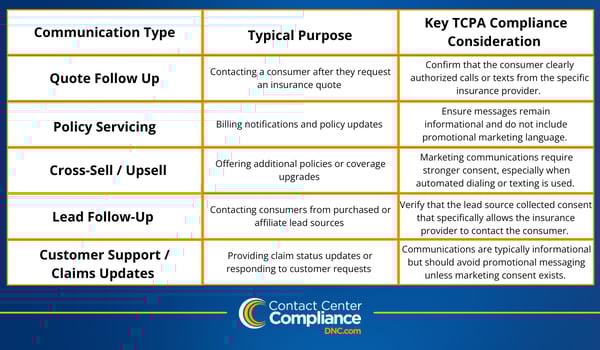
Insurance Outreach Patterns
Insurance customer communications typically fall into several operational categories. Each category can trigger different compliance considerations under the TCPA depending on the technology used and the purpose of the outreach.
2. Regulatory Layers Affecting Insurance Outreach
Insurance compliance does not operate under a single statute. Instead, it exists within several overlapping regulatory frameworks. While this guide focuses primarily on TCPA compliance, insurance outreach programs must also operate within several adjacent regulatory and industry frameworks that influence how communication systems are designed and monitored.
Understanding these overlapping frameworks is essential when designing compliant outreach programs.
TCPA (Federal)
The Telephone Consumer Protection Act governs the use of automated dialing technology, prerecorded voice, and marketing text messaging.
Key obligations include:
- Prior express written consent for marketing calls or texts using automated technology
- Clear and conspicuous disclosure requirements at the point of consent
- The ability for consumers to revoke consent through reasonable means
- Strict liability exposure for violations
- Broader definitions of automated dialing technology
- Expanded private rights of action
- Higher statutory damages
- Different enforcement timelines
- Scrubbing against the National Do Not Call Registry
- Checking applicable state-level DNC registries
- Maintaining an internal Do Not Call list
- Properly managing Established Business Relationship exemptions
- Consumer privacy notices
- Safeguards for financial data
- Information security obligations
- Messaging content standards
- Consumer complaint thresholds
- Traffic pattern monitoring
- Spam labeling and blocking
Recent court decisions have narrowed interpretations of certain dialing technologies under the TCPA in some jurisdictions. However, because interpretations vary by court and several states maintain broader telemarketing laws, many organizations continue to treat written consent as a baseline compliance standard.
Insurance organizations evaluating dialing strategies should consult qualified counsel regarding how evolving case law may affect their programs.
Mini-TCPA Laws
Several states have enacted telemarketing laws that expand beyond federal TCPA requirements.
Notable examples include statutes such as the Florida Telephone Solicitation Act (FTSA), the Oklahoma Telephone Solicitation Act, and similar provisions enforced under broader consumer protection laws in states like Washington, Maryland, and California.
These laws may introduce:
- Broader definitions of automated dialing technology
- Expanded private rights of action
- Higher statutory damages
- Different enforcement timelines
As a result, insurance compliance programs must monitor state-level litigation and regulatory developments continuously.
Federal and State Do Not Call Regulations
Insurance outreach must also comply with federal and state Do Not Call requirements.
This typically includes:
- Scrubbing against the National Do Not Call Registry
- Checking applicable state-level DNC registries
- Maintaining an internal Do Not Call list
- Properly managing Established Business Relationship exemptions
Because insurance providers often operate nationally, systems must be designed to account for fragmented state-level requirements.
GLBA and Data Handling
Insurance organizations that handle financial or health-related data may also fall within the scope of the Gramm-Leach-Bliley Act (GLBA).
GLBA requirements may involve:
- Consumer privacy notices
- Safeguards for financial data
- Information security obligations
Even when outreach consent is valid, improper handling of consumer information can create additional regulatory exposure.
Carrier and CTIA Enforcement
In addition to legal compliance, messaging programs must account for carrier and industry enforcement frameworks.
Carriers and CTIA guidelines may impose controls related to:
- Messaging content standards
- Consumer complaint thresholds
- Traffic pattern monitoring
- Spam labeling and blocking
As a result, organizations must manage both legal compliance and deliverability health to maintain stable outreach programs.
Core Compliance Controls for Insurance Outreach
Once the regulatory landscape is understood, organizations must translate those obligations into operational controls across their dialing systems, lead sources, and outreach workflows.
Insurance outreach programs typically rely on multiple vendors, dialing technologies, and messaging processes. As a result, TCPA compliance is supported by several core operational controls.
Insurance organizations should regularly evaluate three areas:
• Consent integrity — ensuring that consent language, documentation, and scope properly authorize outreach
• Vendor and lead source oversight — maintaining visibility into how leads are generated and how outreach is conducted
• Dialing and network performance signals — monitoring carrier feedback and call performance indicators that may reveal compliance or reputation risks
The following sections examine each of these operational control areas.
3. Consent Framework for Insurance Campaigns
Consent Failures are a frequent source of TCPA Litigation in the insurance industry.
Because insurance outreach often spans multiple campaign types, consent must be evaluated in the context of how each communication occurs.
Quote Request Follow-Up: Where Consent Language Often Breaks Down
When consumers request insurance quotes, follow-up outreach is generally expected. However, organizations should verify that:
Consent clearly identifies the entity contacting the consumer
The disclosure references automated dialing or messaging technology where applicable
The consent record includes a timestamp and documentation
The lead source is clearly documented when aggregators are involved
Consider the examples below:
.png?width=509&height=297&name=TCPA%20Compliance%20Guide%20for%20Insurance%20Providers_Graphics%20(1).png)
At a glance, both appear to authorize outreach. In practice, they create very different levels of clarity and documentation.
.png?width=508&height=296&name=TCPA%20Compliance%20Guide%20for%20Insurance%20Providers_Graphics%20(2).png)
In many cases, these types of gaps are what determine whether consent can be successfully defended.
Note:
Consent requirements depend on the specific structure of the outreach program, the technology used, and applicable state and federal laws. Organizations should evaluate consent language in the context of their full compliance framework and seek legal counsel to ensure compliance with all disclosure requirements.
Renewal Notifications
Renewal notifications are often operational in nature but can easily cross into marketing territory.
Compliance teams should evaluate whether the communication:
- Is purely informational or includes promotional content
- Introduces cross-sell opportunities
- Triggers marketing classification under TCPA rules
Cross-Sell and Upsell Communications
Cross-sell messaging carries higher litigation exposure and typically requires careful consent evaluation.
Programs should ensure that:
Consent language matches the scope of the outreachAdditional products fall within the disclosure consumers agreed to
Revocation requests are honored across product lines
Lead Transfers and Affiliate Consent
Insurance providers frequently receive leads through affiliate networks, co-registration flows, or third-party marketing partners.
In these models, consent is often collected by one entity and transferred to another. As a result, the insurance organization must be able to demonstrate that the consent obtained by the lead source properly authorizes the outreach that follows.
When evaluating vendor-provided consent, organizations should confirm:
Whether consent was entity-specific or generic
Whether transfer language was clearly disclosed
Whether the original landing page is preserved
Whether consent evidence such as screenshots or HTML records is retained
Vendor-provided consent without supporting documentation may be appear sufficient operationally but becomes significantly harder to defend during litigation.
Example: Vendor Lead Documentation
.png?width=578&height=337&name=TCPA%20Compliance%20Guide%20for%20Insurance%20Providers_Graphics%20(3).png)
Reassigned Number Risk
Even valid consent becomes invalid when phone numbers change ownership.
If a number is reassigned and the new subscriber never provided consent, outreach may violate the TCPA.
Organizations that properly query the database may qualify for a limited safe harbor if a reassigned number is contacted after the database indicates no reassignment.
Some states have begun imposing additional requirements around reassigned number verification. For example, Maine requires telemarketers to query the RND, and legislation proposed in states such as Missouri has considered similar requirements.
To mitigate this risk, insurance organizations should incorporate reassigned number verification processes and maintain a consistent scrubbing cadence.
4. Vendor and Lead Source Liability
Insurance customer acquisition often depends on external partners such as affiliate networks, lead generators, data brokers, marketing agencies, and outsourced call centers.
While these partnerships expand marketing reach, they also introduce compliance risk.
Under TCPA enforcement trends, liability frequently flows upstream to the brand benefiting from the outreach. Courts often evaluate whether the organization exercised appropriate oversight over vendor activity.
Common operational gaps include:
- Limited visibility into consent collection practices
- Absence of vendor audit rights
- Heavy reliance on contractual indemnification
- Inconsistent synchronization of opt-out and revocation requests
- Illegal spoofing of caller ID information
- Using dialing practices that trigger carrier spam labeling or call blocking
Vendor Oversight Questions
.png?width=577&height=336&name=TCPA%20Compliance%20Guide%20for%20Insurance%20Providers_Graphics%20(4).png)
Organizations that treat vendors as extensions of their compliance environment are significantly better positioned to prevent and defend against TCPA claims. While the considerations above are a starting point, organizations should work with qualified counsel and compliance professionals to evaluate vendor practices in greater depth before launching outreach campaigns.
Even when consent practices and vendor oversight are properly managed, outbound outreach programs can still encounter operational disruption at the network level.
5. Dialing and Deliverability Risk in Insurance
In addition to legal compliance controls, outbound dialing programs face operational scrutiny from telecommunications carriers that monitor calling behavior and network traffic patterns.
Signals that may indicate potential deliverability or compliance issues include:
- Abnormal SIP code patterns such as elevated 603, 480, or 486 responses (can be found in your Call detail records)
- Increasing spam labeling rates
- Rising complaint volumes
- Sudden spikes in dialing traffic
- High-velocity lead uploads
These indicators often surface before formal complaints or litigation occurs.
Example Callout
.png?width=562&height=328&name=TCPA%20Compliance%20Guide%20for%20Insurance%20Providers_Graphics%20(5).png)
Organizations that monitor dialing health metrics alongside legal compliance controls are better able to maintain stable outreach performance and avoid disruptions caused by carrier intervention.
6. Pre-Launch Insurance TCPA Verification Checklist
Before launching a new outbound campaign, organizations should confirm that core compliance controls are in place.
Consent and Disclosure
- Consent language reviewed and validated
- Entity-specific authorization confirmed
- Disclosure includes automated technology where required
- Consent records timestamped and retained
Do Not Call Controls
- National DNC registry scrub completed
- Applicable state DNC lists scrubbed
- Internal DNC list synchronized across dialing systems
Reassigned Number Controls
- Reassigned Numbers Database scrub performed within the required window
- Ongoing RND verification cadence documented
Vendor Controls
- Consent documentation retained from lead source
- Vendor audit rights contractually defined
- Revocation workflows aligned between organizations
Operational Controls
- Opt-out mechanisms tested
- Revocation processing verified end-to-end
- Dialer logging enabled and retained
- Complaint escalation procedures documented
7. Ongoing Monitoring and Governance
TCPA risk in insurance rarely comes from a single mistake. More often, it develops gradually from events such as a consent record that can’t be traced back to the original form, a lead vendor whose practices aren’t fully visible, a dialing pattern that begins triggering carrier blocking.
Because insurance outreach often spans multiple systems, vendors, and communication channels, compliance has to be built into the operational workflow rather than treated as a one-time policy decision.
Organizations that maintain clear consent records, monitor dialing signals, and apply consistent oversight to vendors are generally far better positioned to prevent and defend against TCPA claims.
This guide highlights several areas that insurance organizations should evaluate, but every outreach program has its own structure, technologies, and risk profile.
If your team would like help reviewing dialing practices, lead programs, or messaging compliance controls, you can speak with a Contact Center Compliance specialist to walk through your current setup.
Request a Compliance & Deliverability Review
